An Introduction to the Economics of Systemic Variance: The common origin of the employment transaction.
Labour Market Institutions (LMIs) are structures and mechanisms of social order and cooperation governing the labour market. Together, they attract much attention, being the focus of 'structural reform' debates common to almost every economy. In academic literature, a division between the Institutional and Neo-classical schools of thought has led to a polarization of thought which until recently left the topic mainly avoided by researchers and thus, unfortunately, neglected. I contribute a framework that acknowledges both property right and transaction cost dimensions to LMIs, going some way towards reconciling the theoretical impasse. An LMI may be interpreted as conferring a property right on the human capital of the labour market participant exchanged for wages, and also, a transaction cost for the firm in the transaction. This framework has as its base unit of analysis the employment transaction and the resource in question being human capital. In a modern, industrialised economy with a highly educated workforce it seems useful to move past a classical conception of a stock of labour to a more contemporary conception of augmented labour. In line with this I use the term human capital to describe what the labour market participant transacts for wages in the market. Amartya Sen (Sen 1997) explains that human capital concentrates on the agency of human beings - through skill and knowledge - in augmenting production possibilities, and as, human qualities that can be employed as capital in the same way physical capital is. A legal entitlement of a person to engage their labour for employment may be viewed as a form of human capital with a certain value to those involved in the transaction. A social security number may be legally augmented by qualifications achieved under a national certifications framework. These certifiable facts are interpretable as a form of property. Sen distinguishes this from 'human capabilities', which are the non-economic freedoms enjoyed by the individual.
Further, the categorisation of the LMIs of mainstream study into 'Employment Protection Legislation', 'Wage Setting' and 'Unemployment Insurance and Active Labour Market Policies' themes, makes a systemic interpretation of the individual structures and mechanisms possible. This is especially so when we consider them as mediating the transaction of human capital between firm and labour market participant in the labour market. Both sides must align within an institutional matrix of state governance dictated by a polity. The bargained arrangement of a labour market systems constituent LMIs, neccessitates the state reconciling their property right and transaction cost dimensions for governance to be both efficient and effective. In practice, theoretical elements from both the main relevant schools of thought are adopted. There are different ideas on labour market dynamism, national competitiveness, and flexibility. b>Some progress towards a more valid approach to the labour market component of the national social system matrix is suggested. The effectivenss of the judiciary system, the efficacy of governance arrangements and the efficiency of the civil service are the reality of a well-functioning system. Also key is the consideration of national ethos. (See Stein 2008, Myrdal 1968)
The most recent European thought on LMIs involves dividing them into categories and explaining what are in my view their often conflicting transaction cost and property right dimensions. The European Employment Semester Thematic Factsheets publications concerning the labour market and skills of 2017 appreciate the often conflicting interpretations of LMIs. This multi-dimensionality was voiced as a concern of what was the standard approach to labour market study in an earlier mainstream debate. I suggest that both the Neo-classical and Institutional schools provide valid accounts of the role of individual LMIs, but that the main differences in the argued consequences follows from whether a rights or costs perspective is taken. Policy-makers must adjudicate on the offered theory and prescriptions, achieving a balance in what will ultimately be politically bargained arrangement outcomes. In 2005 a European Commission report on LMIs and labour market performance stated that the fact that LMIs are multi-dimensional makes it difficult to identify in aggregate panel regressions the impact on unemployment of interactions between all different policies, all institutions and all shocks. (Arpaia and Mourre 2005) It seems that an earlier effort to 'prove' through causal logic the negative effects of LMIs on the unemployment rate have been inadequate and this work can only be useful when used in conjunction with lnstitutional work that brings property right perspectives into consideration. The systemic approach is now proving more useful.
Once this framework of the labour market system is understood, comparative analysis both across and within national labour market institution arrangements suggests a 'systemic variance', whereby similar exogenous determinants across economies can transmission through individual labour market systems differently. Evidently, shocks produce a variance in system performance when comparisons are made from a growing choice of indicators. Measurable governance arrangement models allow for a categorisation or typography of governance, which can arguably be linked to economic and social outcomes. The institutional matrix governing the employment transaction consists of an interdependent web of institutions and associated organisations which together constitutes the labour market system. There is a distinction of the First Order involving similar systems, and Second Order involving dissimilar systems, in systemic variance. According to work for the European Commission, the role of policy design, at both the micro and macro level, becomes crucial to achieve the objective of a well-functioning labour market. (Arpaia and Mourre 2005) It seems apparent that national debates on labour market governance quite often involve judgements on the efficiency and effectiveness of the LMIs in question. These two aspects can often conflict and trust among social partners has been highlighted as more important than the academic or legal particularities. (Blanchard et al 2013)
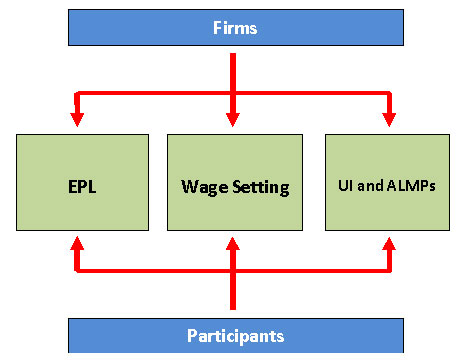
Labour Market Institutions (LMIs) are the structures and mechanisms of social order and cooperation governing the employment transaction, together amounting to an institutional matrix which must be negotiated by both the firms and participants of an economys labour market. Examples include the labour court, severance pay, minimum wages, union recognition, PRSI, public employment services, further education and training, etc. They can be costs or rights depending on your side of the transaction.
LMI efficiency is judged in relation to the facilitation of the labour markets allocation of human capital to the most productive use keeping unemployment to the minimum.
LMI effectiveness is evaluated on the basis of an LMI facilitation of the labour markets allocative role, as this relates to defined considerations external to the employment transaction.
In somewhat Liberal labour markets, the property rights dimension to LMIs concerning the participants agency of their human capital is less emphasised by the state in the mediation of LMIs. A liberal labour market system has less governance and more reliance on the price mechanism for controlling the employment rate. There is less mediation. Given their inherent duality for being also transaction costs, their popular and academic conception is dominated by rigidities perspectives given the political and cultural power of firm and financial organisations. It is observable that the data indicators are more volatile in such countries, with a more pronounced normal business cycle and with more severe crises. LMI effectiveness, judging the employment rate alongside socio-economic data, is also questioned by other opposing organisations on issues of social cost. Current mainstream thought is now responding to popular demands to address a range of concerns, by formally measuring these issues through the use of indices such as the OECDs Better Life Index. Methods more associated with the Institutional School are influential in constructing this index, as is the case with the new Eurostat Social Deprivation Index.
Correspondingly, Coordinated labour market systems that are associated with historically and relatively stronger labour market participant organisations give rise to questions over the efficiency of their LMI arrangements. Many transaction costs analyses of the particular and general arrangements of structures and mechanisms related to labour market governance can be found in the mainstream literature and these analyses broadly amount to a criticism of adaptive efficiency. Delinking the more financial focused sectors from what Eurostat calls the Non-Financial Business Sectors, might allow for better public deliberation over the stability of the macro-environment, gross fixed capital formation, skills needs and other concerns more closely associated with the needs of firms and their representative organisations. While this new distinction between two groupings of the offical fourteen economic sectors of employment sustains the need for Neo-classical analyses, it may be that conserving national ethos is a more strongly valued consideration in such societies. The funding of public education, and availability of further education and training, along with the funding of civil society organisations, is usually seen as the best means of interpellation; which concerns the introduction of common communicable ideas of national importance and an understanding of national politics among citizens, in a changing world. This lends growing support to Institutional school theory and methodology among the mainstream of the community of practicioners.
While already having been amenable to an attempted econometric analysis that sought to explain the differing unemployment rates among countries as a result of LMIs, numerical estimations of modes of governance by international organisations have opened space for political-economy explanation. This form of characterisation between liberal and coordinated types is now mainstream given the observed arrangement differences of country LMI categories individually and collectively. The OECD provides ordinal scores for institutional arrangements given considerations concerning each of the categories among its member countries. Much can be learned from putting these characterisations alongside a growing list of data indicators including job churn, sectoral productivity, and more that are being collected by many organisations including Eurostat and national research institutes. It seems that liberal EPL arrangements lead to higher job churn, which means that people are entering and exiting employment transactions more frequently than in somewhat coordinated systems. A higher degree of centralisation/coordination in wage setting arrangements characteristic of the coordinated type systems, mean wages and unit labour costs seem more stable in these systems over time. It is also observable that for the remaining category of LMI, expenditure by the state is lower in somewhat liberal systems. This is because that form of expenditure is valued less as a macro-economic automatic stabiliser by government, and more as a micro-economic incentive for the individual to enter an employment transaction. The two key schools of thought offer more theory, but national systems differ largely between the balance struck between a 'job first' and 'human capital' approach in relation to the unemployed. Equiping labour market participants with human capital is more effective in the long term for them avoiding unemployment. It can be seen that the wage setting category's Pay Related Social Insurance mechanism sustains many UI and ALMP systems of the OECD member countries and involves a balance of contributions from both sides of the employment transaction. The term 'structural unemployment' has opposing meanings among the schools, with the European Commission working from a human capital holders basis for its definition. In their definition the labour market participant has skills and competences no longer of use by firms. While the Neo-classical belief is that anything which prevents a pure market mechanism in its control of firm and labour market participant decision making, like a minimum wage, is a structural variable because supply and demand are not being allowed to reach an equilibrium price for labour.
It is argued that a degree of First Order or Second Order 'systemic variance' is found in many common labour markets across the global economy given heterogeneity in LMI arrangements. The same cause can have different effects and even with a common currency. The argument that both modern fiscal and modern monetary policy require an acknowledgement of there being a two-way channel between the labour market and broader economy is perhaps more stronger today given growing evidence of the endogenous role played by LMIs. It is obvious that the 'rules of the game' in the labour market are linked to the financial economy, with consequences for the society and political system. There is a reality that economists should acknowledge. Acemoglu and Robinson (2013) emphasise that economic policy should not just focus on removing market failures and correcting distortions, but its implications for future political equilibrium should be factored in, particularly when the distribution of income and rents are considered within an imbalanced political context. The literature on LMIs requires a new engagement with the various indicators sooner rather than later as public debates ultimately relating to efficiency/effectiveness distinctions of the labour market can be quite polarised, with serious social and political consequences given the central role of the employment transaction in modern and future societies. In a recent case-study of the management and institutional response to severe crisis in Ireland, a standardised semi-structured interview using the offered framework allowed a range of stakeholders lots of space to discuss the realities and perspectives of citizens on both sides of the employment transaction. It may have been interpreted simply as a compromise between rights and costs, but among these policy practicioners a bias towards one or other of the two competing schools was clearly evident. Their mental models of the labour market system were influenced by a localisation of a body of international literature. While the case-study showed that the main starting assumptions of Neo-classical theory concerning the labour market have important truth among the differing sectors of different economies, building further and further mathematical theory in pursuit of the nineteenth century blackboard ideal of a single grand unified theory of every labour market on earth has predictably failed. (See Saint-Paul 2000, Pissarides 2001) It seems that the Institutional school provides a practical frame of reference outside of competitive academia and any number of what would seem revealing insights to an interested or young audience were gleaned from well experienced people with public profiles actually paid to be actually responsible for other peoples welfare in one of the worlds more dynamic and english language operated economies.
Attempting to reinterpret old glib notions, that the entire collectivity of a nations labour market participants would be reduced, or 'conceptualised', as a single big lump of unthinking labour who were just good for mindlessly competing with each other to be as happy as humanly possible, with the political reality of their individual legal rights over what is essential human capital ignored from the students view, and that they could still posture that a headline in the broadsheet was all the good students really needed; this dressing of trite ideas as 'values' so that the passions of some of the more simple would earnestly believe that the old romance of a simple supply and demand curve, followed by a little more elaborate wage curve, being the preparation of a small but noble elite of postgraduate students, whom being intentionally limited to mathematics could then rise towards high powered career research and strident public debate, is dissappointly still cherished by some adult unfortunates. They actually have a secret society that is too confused and self-loathing to express itself as a political movement and 'dared not speak its own name'. (See Mirowski 2014) But even dizzingly further, please try to imagine a new and universally applicable 'wage curve' that could lead to just one doctoral thesis and that which had findings contained that could be representable on a simple graph, or in a textbook written in any language on earth, and that then as a logical consequence of all of that mind awakening, the Catholic Church would revoke apologetically their Papal Edict 'Rerum Novarum' of 1891, harkening a cool new scientific reality tomorrow. The thrill of ushering in one of their own as the new lucky winner/leader of a brave new neo-liberal world as described in the pure childlike language of Hayek back before the war. But does this dusty old 'interstate federalism' really now necessitate the new dummed down mentality of the Rodrik Trilemma and its officer class of juvenile narcissists.
Founding everything on the cult of efficiency has effectively created a production line of shameless anglophile performers offering the hopeful a good deal so as to share the new special altar and is anything imaginable but a courtyard of genteels. The sentence in the mentioned Edict on mutual agreement is just one of many I really enjoyed reading following the case-study and easily fits not just the framework, having as a novel base unit of analysis the employment transaction; but it also fits whats happening now on both sides of the atlantic nicely. This is why the case-study was such a social success. There is also a sentence on viewing the worker solely for his physical powers. More recently, practical mainstream economic research in the interest of ordinary firms is seemingly not conducted. This means that the traditional political supporters of business interests have regressed to populism in some nations as a direct result of the more zealous Neo-classical schools supporters pathetic expedience of concience. These economists deliberately ignore the reality of workplaces and politics because they can then plead ignorance in the public realm. Time and time again, their short-sighted and doomed attempt at a godless clinical interpellation of their own and mostly other nations citizenry, is claimed as moral because it has allowed a few of their true of heart performers to take the stage. These performers learn the admission and then the choregraphy of the ignorance racket and they all inevitably resort to pretense and empty jingoism. They realise what they have learned is useless and so they smile and threaten in an escalating mess of their own making. They know very well they must expediate their own concience for their own well-being and survival, thus through ignoring reality, their small math limited theory is still some form of moral law from above in their own minds. This allows them a shared conviction that they must only follow self-interest, ironically so that each culprit is from start to finish performing for their own individual ignorant cursed temporal prosperity.
Systemic variance in a common labour market and the culture counter, will folllow soon on this site.
Book out soon: "democracy in the core - when paradigms clash" (2019)
The below was added to this website in May 2023.
I think that the most powerful force in western politics is the confidence of a clear conscience. It takes a lot of moral courage to contemplate a renunciation of something more ordinary. Assuming a public profile is far past the imagined speaking in public trial of a typical individual. The person must represent themselves as a better public representative than other members of the public, even though they don't know exactly what they are going to encounter when elected. It is only when successfully elected that the politician emerges.
Then they must sustain the belief that they are a better representative through uncertainty. It partly depends on their value system now, something the successful would always have had in play. The relative importance they attach to ideas is key. It partly depends on the sustainability of their belief system, the series of connected ideas that are organised internally to make sense of the reality around them in a meaningful way, and this belief system is something that will be challenged. Then they need moral principles.
The British system of government doesn't really prepare their politicians. There was a Prime Minister who had the media sewn up safely until it had the potential to manifest his deepest desire. At his command, the whole thing could all be wished into a global drama of his making, and then with a definite victory assured, his immortal place in history could have been earned, wonderfully. So he kept going.
The adversarial system of government is strange to voters in countries where coalitions are made between different parties of public representatives. There are all types in a political party and many different ideas happen all the time across the public deliberation of policies and actions. I don't think this is a constructive account of Machiavelli. I don't think the guy would have chased headlines, which is the logical course of action from such an individualistic portrayal. I think that with an adequate social protection system he would have built himself into a public role honestly.
I think that a politician would understand the necessity of a clear conscience to his public role. He would figure that this would in time earn him survival, when he couldn't expect what was to happen beyond his control. They have to keep thinking honestly, because it is the credibility of a politician’s ethic, their set of moral principles, that they have represented among the other polity, that helps them survive the public trial. The conscience can be a powerful force.
The person must often defend their principles and thankfully we now have public representatives that can serve as examples of ethical conduct. I think that people more often reward a person’s good conduct in the balance of estimating their general worth. There are always different ideas on a person’s suitability as a public representative. I think it goes wrong when a politician simply acts the part as the better representative in a natural attempt to fool the public. This used to be called 'playing to the gallery.'
In the case study a range of opinion and theory is accommodated and referenced by a broadly mainstream examination of the period of crisis. This provides new insightful learnings into the workings of the labour market system. Although the provided explanation of the Irish experience builds on much existing material and mainstream thought, it became necessary to develop this work further through a compromise of the competing paradigms into a suggested new framework of Labour Market Institution study. This new framework might be described as Systemic Variance.
In the statement of objective, I promised that the case study could be all that a researcher needed to conduct their own work. The beginning labour market narrative that contextualises everything in the chapters that follow, relied on downloading data from the state statistics office and then picking it into the three categories. Each citizen must consign themselves having reached adulthood to any of one of these categories at different times across their lifetime. This categorisation of statistics might seem obvious now. But my aim was always towards a master model, or Gestalt understanding, which I knew that policy makers themselves used when framing policy. This use of metrics solely as a means of context building towards finding solutions is now part of mainstream practice. The explanation of mental models as within an observed context, as with the case study, is also now more common because of it being a more pertinent approach to policy choices in a more differentiated global economy.
Fortunately, the academic battle over the term Measurement-Invariance-Analysis was won here in Europe and we can imagine cooling down the pot for the pensions of our grandchildren. The term was used when tackling the problem of evenly and consistently measuring social deprivation across very different European member states. It should be noticed that an alternative Measurement-Variance-Analysis designation would stretch things even further for the Neoclassical school, producing more confusion and more coming apart in our community. This other term would not have fostered a context building that was workable and thus prevent a policy making process that was done fairly and equitably in the interest of each affected citizen. The second term in the paragraph might have encouraged a huge number of academic papers but then less enlightenment. This would likely have only confused the community of practitioners. The real hope is that economics can reconcile itself with the agreed aims of the global community within the shared global means.
It can be said that the Irish labour market system is a liberal type of arrangement. This has implications for the study and research into its further development. The economist might now need to understand the political economy of such an arrangement. As with a coordinated labour market system. But this demand that we understand the liberal rationale might not be too difficult in the Irish case. I understand that Ireland did not experience the industrial revolution in the same way as other European states. This meant that a more powerful labour movement only emerged later in our history. It also means in my opinion that the Papal Edict Rerum Novarum of 1891 is still very useful, even without its complement Quadragesima Anno of 1931. The early European drama of industrialisation and early capitalism involved old ways of economic and social life being destroyed. Hence there is a strong normative consideration to political economy that has given rise to an ever-present Marxian criticism and the always developing Catholic teaching. In the Irish case we have enjoyed an economic convergence since a later European Union membership.
In the earlier political economy aimed Edict it is stated by Pope Leo XIII that “mutual agreement results in the beauty of good order, while perpetual conflict necessarily produces confusion and savage barbarity.” This human concern within the drama of early European industrialisation is shared in a sense by the early Marx concern with gross alienation and social fracture. In this epilogue I want to contribute my own claim that the offered framework of Systemic Variance can accommodate the always competing narratives among policy maker and polity mental models, into something more human and still scientific for either the liberal or coordinated labour market system. It is new and accommodates clear theoretical ground, evidently yielding real agreement on themes that are relevant in the lives of working people. It can be a popular way to explain economic and social differences. In the Systemic Variance framework, the primary market is the labour market, the base unit of analysis is the employment transaction..
It is fact that our global means are now impinging on what are termed planetary boundaries. The era of frontier capitalism is over. When the Coase theorem became prominent there were not then many considerations apart from the profitability of the individual firm. The transactions within the firm and between the firm and others would necessarily guide the economy towards producing a better society. It could be assumed that all commercial transactions were guiding us towards better ends using what was naturally by the market mechanism an optimum allocation of means. The purported growing prosperity served as a justification of the market economy.
The community of practitioners now acknowledge that there is a social cost to consider. This new reality of boundaries on our thirst of passion and greed of possession, is placing more emphasis on property rights. It was once easy to sublimate environmental concerns with the view that generating prosperity was a greater good. The Ronald Coase paper that addresses social cost has a huge number of citations by legal scholars. It allows a person to sublimate any concern as to economic, social or cultural cost. The necessity of my negation of a recent version of the Coase Theorem can be viewed as the other side of the coin. Where there are unavoidable transaction costs and also property rights that matter.
In the case study the base unit of analysis was the employment transaction. The case study can easily fall under the category of political economy with its use of the human capital concept because this concept is itself part of a so-called capabilities framework that builds on human rights. In my labour market framework the individual worker transacts his human capital for a wage in a transaction, with a firm having uses for their human capital in its production of goods or services. This can complement the idea that the individual worker also has human capabilities that are quite separate to the transaction. This should be a consideration of the modern policy maker. Hence, I needed to include an appreciation of labour market institution effectiveness, as well as efficiency. This general move away from the representative agent maximising his utility is proving far more useful in development economics. There is a social good that matters.
In the case study I have shown that stepping back from the wage mechanism provides a much fuller ground for discussion and agreement. The labour market has both an efficiency and effectiveness measure under Systemic Variance. The use of the human capabilities framework is founded in a rights-based approach to development. These rights imply transaction costs, but they also imply the social good. It was always about the best use of limited resources towards agreed ends, but now considering a broader conception of the social good. This now seems also pertinent to maturing liberal democracies in an era of planetary boundaries.
The Irish economy is adapting structurally to a host of economic and social realities. In the case study the primary market was the labour market. This market is underpinned by certifiable human capital. But once again it is essential to step back from the nominal wage mechanism and understand the role of the broader educational framework. The requisite supply of healthy, educated, socialised workers for firms, requires a governing system that supports the property rights of individuals who engage themselves in an employment transaction with a firm. It should be clear from the case study that future adaptations of the Irish economy will involve the education system and the individual rights of labour market participants.
It was always generally the case that property rights carried a broader importance and role. With the Coase Negation I ascribe property rights to the individual labour market participants human capital. It is also true that I suggest an economic and social good to the structures and mechanisms of social order and cooperation governing the labour market, labour market institutions. The coherency and comprehension of this approach among Irish practitioners can be seen as a turning point in the history of our country. A time when Alexander Kojeves announcement of the “rational supremacy of the regime of rights and equal recognition”, had finally arrived. But the Irish example shows that regulation as apart from individual litigation can serve society better. This distinction is crucial to appreciating the rights-based understanding of the economy, as well as the traditional bias in economics to reducing transaction costs, the other side of the coin..
“In the absence of transaction costs, the Pareto efficient allocation of resources is independent of the allocation of property rights.”
“In the presence of transaction costs, the Pareto efficient allocation of resources is dependent on the allocation of property rights.”
The Coase Negation hinges on a person-centred understanding of economics and it might be used to argue the primacy of the labour market in matters of both development and developed structural adaptation. But it crucially still allows for any social good that can still come from an understanding of the original. Considering both sides to the coin, the ‘real economik’ need not be entirely legalistic, while accommodating the interests of both sides of the transaction. The fact that labour market institutions are essential to labour market governance makes the presence of some transaction costs unavoidable. In his social system matrix, Gunnar Myrdal provided a short list of headings under which Asian economies could judge and manage economic development. He dedicated a heading to institutions, that emphasised the strength, efficiency, and effectiveness of these market economy necessities.
Taken as one part of the overall framework in this case study, I hope to have conveyed the necessity of the negation to a bottom-up approach to development. This acknowledges human capabilities through useful specialisation, within either a liberal or coordinated leaning arrangement of the labour market system. The fall of the Guild System was highlighted in Rerum Novarum as something to regret. But we are now somewhere different. This is an exciting time in economic and social science. This case study is one story, that I have told with emphasis on the role of education and skills in a liberal economy. A key part of the framework is that labour documents and certificates are the human being’s own property which the state must wholly vindicate in its own interest. It is a theory of the labour market participant.
In the case study I made use of Douglass Norths definition of the institutional matrix. This definition includes not just institutions but also organisations. If I were to have just studied the institutions, I would still have produced something similar to the Systemic Variance term. This term denoting differences in systems is suggested in the original conclusion of my literature review. I was aware that there were commonalities in labour market measurements and a common body of theory, with observed differences in national institutional arrangements. There were many possible comparisons that could be made.
But it was by conceptualising the whole in a system approach, given that much was common to observed varieties of capitalism across countries, that a case study presented. The use of a systems approach was supported by my supervisor. The Irish set of structures and mechanisms of labour market governance were forced to adapt to an outcome that radically deviated from expectations. I was concerned with the tinkering of the machine. This reform would bring a changed context for participants and employers, with recovery not inevitable at the time. While it does allow for country differences, it also crucially implies a neutrality, which opens a path of analysis where each side of the transaction is empowered and thus a stakeholder.
The labour market system as a political term, was used openly in the Irish media during a coalition government through the mid nineteen nineties. This was the initial search term that led me to the subject area of labour market institutions and the main impasse among the community of practitioners. Having been unemployed in a liberal type of economy I had some experience of the machine in this context. I understood the demands on the labour market participant. I was also learning about the available supports. I think that Ireland shows how a neutral labour market system can in fact be made something benign. There was space for me to upskill and find well matching positions. Joan Robinson has highlighted hysteresis as an economic fact. This is where an economic event is eventually made undetectable in the data, yet still being significant in reality for an individual or individuals. Fortunately, in an Irish context with a new social contract through recent progressive government policies, I was allowed protections and rights which could be vindicated in part by our new prosperity.
The use of the systems approach to describe the collective mix of labour market institutions is now important in the subject area and can go some way to reconcile the impasse between theories originating from differing varieties of national economies. I think that each European economy needs practitioners having a fundamental appreciation of ideas like the Social Economy Program and how it requires local leaders. The move towards a stakeholder conception of the labour market can bring us past the wage mechanism and towards a popular compulsion or supportive activation, in the treatment of the unemployed persons and recently participating. There are limits of the price mechanism approach. The existing models of optimal currency area adjustment, come up against a sticky reality. It might not be possible to cut wages or move country. But these two factors could actually be a useful consideration in a New Keynesian prescription for labour market policy. It is now the case that European policy makers have been provided thematic fact sheets to guide their decisions on labour market arrangements. There has already been a move by European officials away from the numeric Labour Market Institution Index of 2015 to what I can uncontroversial describe as a real economy stakeholder approach.
The unemployment crisis that concerned the case study was actually our own endogenous or internal shock which to a novice researcher was without a source in the literature. It had mostly to do with our own imbalanced economy. The supposed soft landing, that did in fact occur elsewhere, might have occurred here if things had not run so far out of line through our own action. The appeal for financial support was then made contingent on structural reform, which in part meant triggering an Irish form of the Activation Agenda. But it was soon apparent that supply side reform can only go a certain distance before some form of stimulus is necessary to get the reforms into action.
In this case study I tried to show how institutional measures and actual people interact in what I argue is the primary market of the economy. It may truly be said that it is only through the labour of working men that a nation may grow rich. The supported actions of participants allowed the labour market to kick start the recovery, when whether newly skilled or reskilled took on new employment transactions. There was also a cohort who were well educated enough to emigrate with a degree of confidence. Now there are more ideas possible on agreed means, as well as ends.
There is also a lesson that flexibility is best built on both supportive activation and popular compulsion. It is vital to put the labour market participant first when considering the labour market system. The aim of the narrative beginning the case study was to help the reader to appreciate how each individual story of reskilling or emigration was together the task of policy makers. These individuals moving employment status and economic sector were together shaping the broader economy and society. But I always wanted to centre the analysis on the labour market system. The institutional matrix constitutes this system through its interdependent web of organisations and institutions. The purpose of the institutional matrix model I provided was to humanise this broad labour market system using the base unit of analysis in the labour market, a transaction between the labour market participant and a firm. This placed things into a New Institutional Economics frame and then with a novel application of the so-called Coase theorem it became essentially civilised, with stakeholders emerging out of the data, each on a neutral legal basis.
A question arises from the observation of labour market reform arguments as to the role of this theoretical discord in the rearrangement of the labour market system. The conclusion of my literature review was that contemporary capitalism exhibits a wide variety of models. The question was localising the theory and econometrics into policy actions that suited the Irish context. I found that each paradigm could provide evidence and when I talked with stakeholders about policy, the established differences among national models was possibly most to the fore in their considerations. There was common ground on labour market institution terminology and measures. There was already an understanding of different national models. However, the institutional matrix adapts, because it cannot simply adopt in one instance one or other of what are majorly differing models. The localising of academic material is necessary because of the ‘real economik’ being different in each country.
But also in my consideration is that the overarching theoretical impasse had itself begun in an initial ‘real economik’ difference among countries. The eventual success of the European regime of rights had then presented an academic case for the coordinated model. This case for coordination mainly concerned theory from the Institutional school. These economists had succeeded in part because of a popular support for their prescriptions being political reality. The fuzzy process of policy design will typically lean towards either school of thought depending on where the institutional matrix is now, this being dependent on the prior politics of past stakeholders. The institutional matrix adapts because it cannot stably adopt one foreign model or another in one instance.
There is a debate that concerns alternative national models as examples. But there is a theoretical need for commonalities. There is a need for policy decisions in times of crisis and in times of stability, towards reaching agreed ends. This is always a fuzzy process and the evidence available to decision makers during the unemployment crisis was mixed. I showed that each paradigm had a role and that each had its arguments in the mix. It can be said that the current LMI prescriptions having most currency among the polity, are somewhat nuanced and judged in relation to a particular development strategy, and with the Irish localisation exhibiting tenets of both schools. The key decision makers might have even not been aware that their own common sense and practical policy arguments came from distinct and often conflicting schools of economic thought.
But most importantly, Systemic Variance has now been tested again, but from an external shock. This is a term likely leading to a popular compulsion or supportive activation understanding of labour market participants through further and further testing the tenets of both schools of the discipline. The interest rate cycles among economies are logically originating in central bank mandates. Where there is a consideration of the unemployment rate, it seems that real labour market support by government is the far better approach for the social good. This is instead of sitting idle, waiting and treating people as a collective metric. The argument I made that Rerum Novarum is pertinent in the Irish case, can be made for other liberal style economies and their labour markets. The worker should not be viewed solely for his physical powers. There is a real cost to urban decay and the hysteresis evident today is found in low protection and low labour market flexibility expenditure. When the community of practitioners forced black board economics into policy decisions, it can be said that mainstream economics became secular authoritarianism. There are observed differences in alienation and coming apart among national models and I argue that the labour market should be considered as the primary market. This is not just from a capabilities perspective, but from the economic reality that it is a two-way channel which exists, between the level of central bank policy and government responses, to the level of the individual labour market participant and the real interest rate they must negotiate.
There are common units of analysis available to assist an analysis of an economy that builds from the labour market. After describing the labour market in terms of an institutional matrix, there are distinct differences between the liberal and coordinated type economic models. This makes it possible to talk of either similar or dissimilar labour market systems. In the Irish case an agreed national strategy of dynamism, competitiveness and flexibility came from a political and institutional reality, while also then guiding an adaptation during crisis after an internal shock. Since the recovery these three touchstones have been tested again, but from an external shock and with a swift return to full employment reoccurring. The variance among national measures that can be observed could easily be described across the three categories as being differences in job churn, stickiness of wages, and effectiveness of stabilisers. The labour market system that could be described as coordinated would probably have produced something less pronounced after both an internal and external shock.
“First Order Systemic Variance describes the observed differences in statistical measures among similar labour market systems."
Second Order Systemic Variance describes the observed differences in statistical measures among dissimilar labour market systems.”
There can be an expectation of future volatility across the financial and non-financial real business economy and then dramatic central bank action. This is true of all economies. But the degree of volatility could likely be more tempered given what is in place and arranged in terms of the institutional matrix of a more coordinated economy. This is largely because of the labour market system. This is because of the real human economic agent acting in the primary market, either engaged or searching for an employment transaction. There is an idealism that gives rise to types of systems. This idealism differs between stakeholders and yet we can judge from the arguments of political and industrial organisations whether the labour market debate is healthy and whether this real economy component is being given the attention it deserves. I argue that this attention should be more than a collective metric and that it can use Systemic Variance to create ground for civil policy debate, even during crisis.
Across different crises and even in more stable times idealism has led to symmetry breaking among the major economies and business cycles that are more pronounced in the more liberal type economies. The numbers return to health but there is a long history of hysteresis lurking. There seems among the community of practitioners to be a return to the human concern and less idealism on all sides, with a call for commonalities. The two distinct orders of Systemic Variance are just as important. It is also true that at this point in the academic debate well-being has become a key factor in the mainstream and this should provide for better policy prescriptions. The representative agent is still useful, but ethics are both borne and existing relative to individual human stories. This is why a capabilities framework that consciously acknowledges capabilities as well as human capital is so important. Now that capitalism is in its stakeholder stage, the community of practitioners do not seem miles apart and mainly because of more nuance in labour market institution ideas, going past a lump of labour striving to be as happy as humanly possible.
Further, this systemic interpretation of LMIs and consequent model of the labour market system is consistent with the idea of an institutional matrix suggested by Douglass North which sought an understanding of economic systems in terms of their comparative performance and development over time. Taking both the initial internal shock of a housing market collapse and then the external shock of a global pandemic, it can be said that Ireland had reached a turning point. It had successfully converged in many respects with other mature democracies of the European Union. The adaptive efficiency relied on a mature appreciation of what our economy had done right and what had gone wrong. These understandings were largely shared among stakeholder representatives of both sides of the transaction in the labour market. The current issue of a global economy knowingly facing its planetary boundaries requires another adaptation. This will likely rely on both a capability’s framework and coercion.
The amount of carbon being released into the environment is devastating across many of the boundaries we are aware. The further mitigation of carbon emissions will necessarily require us to view ourselves as a worker evaluating expected costs and expected benefits in what is produced within the firm, as a consumer accustoming ourselves to new norms, and as a citizen deciding on how we discount the future circumstance of society. Including that we extrapolate forward to the pensions of our grandchildren. This role model approach borrows from Elinor Ostrom in her case studies uncovering how a collective resource could be governed in a sustainable manner. There will be more mutual agreement among nations, with this leading to a definite climate result.
In a modern Edict Pope Francis spoke again of the virtue of times past and how when in more agreement with nature, “it was a matter of receiving what nature itself had provided, as if from its own hand.” There is a discernible concurrence that should emphasise our own human capital as the main resource in adapting back within the planetary boundaries. Human capital is our key asset even within the offered role model approach when maintaining a shared commons sustainably. It is also a limited resource that could be envisaged in an Edgeworth Box. There could be two alternative professions such as scientist and industrial engineer, represented at a certain point in time, both groups continually poised to make their way to a yet undetermined pareto optimal allocation of workers from the general stock of participants. The current wage rate and sectoral distribution could act as a guide in light of agreed ends. This would help policy makers make conscious decisions on future skills needs.
The actual question of how many of each worker and what ends is a normative consideration. In his writings Adam Smith ordered moral sentiments as starting with humanism, then justice, then generosity, and finally public spirit. This indicates a key role for individual justice that should be considered before the purported prosperity of a nation. In another of his Edicts Pope Francis sets out a moral obligation for us all, that we work for a just distribution of the fruits of the earth and human labour. The development in moral sentiment across early industrialisation and into the age of modernism, has produced new moral principles, or ethics. The emphasis of our democracies on the social good and the promotion of distinct and necessary ethics, is not based entirely on a given God.
The creation of the term Systemic Variance is a natural outcome of creating a currency area. The task for different states economies within any currency area is now to adapt as best they can so that they can all arrive at a result within our planetary boundaries. The term can also highlight differences between currency areas. As western politics play out across the ongoing Liberal drama and its counterpoint of the European Charter of Social Rights, there are other currency systems developing within the shared planetary boundaries and that are also building their future from a labour market system. Everywhere, the alternative to a rational and ethical regime of rights in a democratic state, might be a key minority that are enjoying another form of well-being. This case study wants to help others adapt their own labour market and economy to a better egalitarian and emancipatory horizon.
Dr Daniel Patrick Higgins (2023)
The paper I found casts new insight into the relationship between labour market participant and firm. The paper is about the effort to analyse polarimetry data with angular uncertainties. In my own framework the reality is that they have engaged in a legal transaction. Each side must make a subjective jump as to how the transaction is beneficial for their interests and how secure it is going forward. They cannot predict the future entirely. Even as such there is still a causal relationship between each of the parties that is known well enough to willingly transact given their own interest. The matter of trusting the system is still important even while both are protected by the law.
Following my framework, this transaction happens in a labour market system that governs the transaction, this itself being a logical legal construct. The many LMIs together and along with the representative organisations and relevant government departments constitute a labour market system. But the legal reality is itself just one consideration in the broader reality of the competitive market economy. There is also the complex modern connectivity to other economies.
The national labour market system mediates the relationship between labour market participant and firm, but only when it makes sense for each to transact given the broader economic and social environment. The many transactions that make up the aggregate employment rate are each and together subject to this more static systemic reality. There is an aggregate of these transactions in an economy that we can understand as the official national employment rate.
We can thus understand that something logical is happening when we adjudge LMI efficiency, and while less easily so, LMI effectiveness. These two evaluations of the labour market system are useful for economic and social policy. They are measures to adjudge the employment rate in a broader and more useful sense towards deliberating better social policy. The labour market in aggregate is both indicating and shaping the broader economic and social environment.
But we know that the aggregate is also in some way partly determined by a systemic variance, which follows from accepting a model of the labour market system that is focused on the representative transaction. Then with national systems falling into distinct types. The astronomer used an “angular uncertainty” term to indicate his reasons for the use of an explicitly labelled systemic variance coefficient in a mathematical model. The relative health of an economy will change over time, but it can also be partly explained across time by the more static arrangement of LMIs that constitute the labour market system. This is why I think that the term “angular uncertainties” seems apt when trying at introducing systemic variance into mathematical modelling.
The authors need for a systemic variance term seems to have arisen from his effort to analyse polarimetry data. The economist might imagine a growth model and saddle path as having a labour market system consideration. The point where the economy is as represented by the model will change and it may be even predicted. This is like a point in space and time. It is dependant on the aggregate mix of individuals in the labour market across economic sectors and occupation levels. There is in a sense a shared economic polarimetry for each individual in the labour market.
The labour market point in space and time can be analysed and guided, but it is still subject over time to a potential interference that will be in some manner logical given the legal realities of the labour market. There is a real need to include a labour market system type consideration into modelling and with different values. This is something that we can in fact do today knowing that LMIs produce different measurable economic and social results across the national business cycles. This is reasonable given that the labour market is the primary market in every economy.
Following the authors work on the mathematics, it would then be true that in aggregate the labour market system type is now probably best indicated in a growth model with a positive systemic variance coefficient.
What I argue is that in the case of each individual relationship between labour market participant and firm, we can assign a labour market system consideration, measured from either a coordinated or liberal labour market system reality, that amounts to an angular uncertainty. Every transaction is subject to this angular uncertainty and this angular nature is from the legal certainty dictated by LMIs. The arrangement of LMIs can influence the individual transaction for many reasons and then when we consider transactions across a sector or many sectors, we can use a characterisation of the relevant system to better predict and plan. The broad arrangement of the labour market system is together a significant factor in the macroeconomy, but exactly how varies from economy to economy. It can be considered as an angular uncertainty for the individual representative agent, that we should all in turn consider in our own interest.
So, in my understanding of mathematics, the wave function is the broader economy and society model, with a labour market system type coefficient termed systemic variance potentially included in that function. For me the only operator of the systemic variance term in that model is the immediate total of employment transactions. There is a legal obligation to being currently in employment or actively seeking employment. This should be acknowledged by social and economic policy. The labour market type matters.
The employment rate is central to growth, but it has an angular uncertainty arising from the legal reality governing each transaction. This legal reality is different in liberal and coordinated labour market systems. It may truly be said that it is only through the labour of working men that a nation may grow rich. The two-way channel between interest rates and the labour market works out differently among economies and this might be partly explained by a systemic variance.
The relation of interest rate changes to the individual employment transaction is the most obvious but not necessarily most immediate contributor of the employment rate. It is true that supportive activation and popular compulsion lead to better labour market matches. In these cases, the angular uncertainties are less a concern, even across the business cycle. Perhaps the angular uncertainties accompanying a growth model are more or less significant depending on labour market system type.
Essentially the focus is still on you when it comes to systemic variance. Even if your work is secure and LMIs do not feature too much day to day, or they might be something mutually beneficial to both you and your firm, the point is that we all must make a conscious decision on the type of arrangement we want for the LMIs in our own economy. The Irish case study proved that one sectoral imbalance can impact on other more stable sectors when exacerbated by the arrangement type of the labour market system. There is now clear new ground to discuss LMIs. And that we also consider how they relate to the broader economic and social system, like with other instruments of policy.